Cover yourself in Canberra
Condoms, dams, gloves and lube are tools to make sex feel safer, smoother and more enjoyable. Each option offers a little extra comfort, control or sensation, letting you focus on pleasure and connection in the ways that feel best for you.
Condoms, dams and gloves are often referred to as 'barrier methods' when talking about STI & HIV prevention.
Do you recognise these icons? Even icons need protection!

Condoms
Condoms are one of the best ways to prevent STIs (as well as pregnancy), especially if you’re having sex with multiple partners or casual sex. Condoms are generally easy to use, widely available and cheap (or free!).
External condoms (which is generally what people mean when they say 'condom') are a barrier method of protection used to cover a penis, sex toy or other object. They:
- can be used for lots of different kinds of sex, including oral, vaginal and anal sex
- are super flexible to fit different shapes and sizes, including penises and sex toys
- come in different sizes available for maximum comfort and sensation.
Condoms create a very thin barrier which prevents STIs (and body fluids) passing between bodies. They should only be used once and should be replaced if they break or malfunction during sex.
Where to get condoms
Looking for free condoms? We’ve got you covered: check out our map of free condoms across the ACT, including sexual health services and other locations where Meridian supplies our safer sex packs for you to grab on your way through.
Need condoms in bulk, or other safer sex products? We sell condoms in various sizes, as well as a range of safer sex products (available in bulk) at wholesale prices with pick up or delivery in our online safer sex store. You can also buy condoms from supermarkets, pharmacies and adult stores.
Types of condoms
Condoms come in a range of sizes, flavours and texture, and can be made from different materials to suit different skin types.
We’ve broken it down so you can find the right protection for you:
Materials
Latex condoms are the most common condoms you’ll find in Australian shops (like the supermarket, pharmacy or adult stores) or for free at sexual health clinics and other community services (see our free condom map).
Non-latex condoms can be used by people who are allergic to latex or prefer non-latex options. They’re usually made from polyurethane or polyisoprene and can also be found at supermarkets, pharmacies and adult stores. Non-latex condoms are not usually provided for free at sexual health clinics, so need to be purchased.
Textures and flavours
Ribbed or dotted condoms have raised ridges or spots across the surface to enhance sensation.
Flavoured condoms will have a specific taste (like strawberry, banana or chocolate) which can make them fun to use during oral sex.
Sizes
All condoms are created to stretch significantly over a penis, sex toy or other object, but you can get different-sized condoms which might feel more comfortable for the person wearing it. Sizes vary from a closer fit to larger sizes, so if you or your partner find the size you’re using isn’t as comfortable as you’d like, you can try other sizes.
How to use a condom
- Check the date on the condom packet to ensure it hasn’t expired.
- Tear open the packet carefully and check there’s no damage to the condom.
- Make sure the condom is the right way around (to be rolled down). An easy way to remember is that it should look like a sombrero, not a beanie.
- Squeeze the tip of the condom and place it on the tip of the penis or toy.

- Gently roll it downwards to the base of the penis or sex toy.
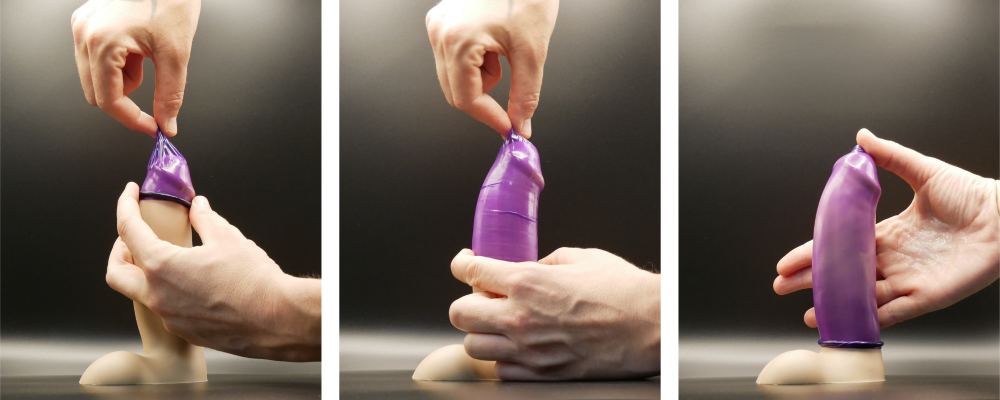
- Apply a water-based or silicon-based lube to the condom before penetration to reduce friction and make sex more comfortable. Do not use oil or oil-based lubes with condoms: it can cause them to break.
During sex, you can pull out to check the condom is still in place and add more lube as needed.
When pulling out, hold the base of the condom so that it stays in place.
When you’re finished, remove the condom (you can tie it up to stop any spillage) and dispose of it in a bin. Condoms should never be flushed in the toilet.

Remember: don’t double up on condoms! Wearing two condoms or using both an internal and external condom does not make sex safer. Using multiple barriers can cause friction between them which makes them more likely to break.
Internal condoms
Internal condoms are made from a non-latex synthetic rubber material and designed to be inserted into the vagina or anus. They create a barrier which prevents STIs (and body fluids) passing between bodies, and can prevent pregnancy. They should only be used once and should be replaced if they break or malfunction during sex. They are not as widely available as external condoms, but can be found online, at adult stores and at some sexual health clinics. Internal condoms are suitable for anybody but are sometimes called female condoms (or may be known by their commercial name, Femidom).
The great thing about internal condoms is that the wearer is empowered to protect themselves and not rely on a penis or toy being covered.
Internal condoms have two flexible rings, one at each end, which help to secure it in place during use:
The inner ring is closed and is used for insertion. It is designed to hold the condom in place within the anus or vagina.
The outer ring remains outside the body, covering the anal or vulval area, providing additional protection and preventing the condom from going too far inside.
You should apply lube to the outside of the condom for comfort and ease for insertion (particularly for anal use) and to the inside of the condom for ease and pleasure during use.
Find out more about how to use internal condoms for anal sex.
How to use an internal condom
- Squeeze the inner ring at the closed end of the condom.
- Insert it as far as possible into the vagina or anus using your fingers. The outer ring remains outside the body to prevent the condom from going too far inside.
You can also place an internal condom over a penis like an external condom as a way of inserting it if you prefer.
You can apply more lube to the penis or toy for the inside of the condom during sex as needed.
To remove the internal condom, carefully twist the outer ring before pulling out to prevent spillage.
Dams
A dam (or dental dam) is a rectangular sheet made with natural rubber latex which is usually used during oral sex to protect body parts like the mouth, anus or vulva and vagina.
Like condoms, dams create a physical barrier between body parts that helps to prevent the transmission of STIs. They can also appeal to people wanting to give or receive oral sex who experience sensory issues (like taste or smell) or are otherwise conscious of mouth-to-genital contact and want peace of mind.
Dams can be harder to find and usually aren’t stocked at supermarkets or pharmacies. You can buy dams from our online safer sex store, adult stores and some sexual health clinics.
If you want protection for oral sex but only have a condom, you can make a dam with a condom and scissors:
- snip the tip of the condom off
- cut it lengthways from top to bottom
- stretch it out.
How to use a dam
- Remove it from the packaging.
- If wanted, apply water-based lube to the area or part of the body (vulva, anus etc.)
- Lay it flat or stretch it over the entire area or part of the body.
- Hold the edges of the dam during use; the person receiving can usually do this.
Remember: use a new dam if moving from the anus to the vulva.
Gloves
Gloves can be made from latex or other materials.
They can be removed or swapped when you move hands or fingers between body parts, so they can help to prevent:
- STI transmission
- cross-contamination when sex involves hand play or fingering multiple areas of the body
- scratches from fingernails
- exposing a cut or wound on a hand/finger.
You can put on gloves when:
- moving from anal play to mouth or vagina play, because bacteria can be passed from the bum to other areas.
- moving hands between multiple bodies, or from your body to another, because STIs can be passed on this way.
- handling used sex toys before using hands/fingers on another body/body part.
Lube
Personal lubricant (or lube) is used to make things wet and slippery during sex, which generally makes it better! It can be used by all bodies and on different body parts.
Lube works by preventing friction between your skin and a partner’s skin or other materials, like a condom or sex toy. Lube can also be used to reduce friction during masturbation.
Lube can be made from different materials. It’s important to use the right lube for the right situation, because some types of lube can damage condoms and sex toys.
Types of lube
-
Water-based lube goes with everything!
- The best all-purpose lube for any kind of play and the most widely available type.
- Compatible with all condoms and toys.
- Keep in mind: water-based lube will be absorbed by the body quicker than other lubes, so keep topping it up. It will also dissolve if you’re using it in water (such as a bath, pool or shower).
-
Silicone-based lube has a silky, smooth feel, lasts longer than water-based lube and is compatible with condoms.
- Can be used with sex toys that are not made of silicone (like glass or metal) but will degrade silicone toys.
- Can be good for people with sensitive skin and for activities in water.
-
Oil-based lubes often include natural oils (like coconut, avocado or almond) and are very long-lasting.
- Should not be used with latex condoms and other latex products, because they can break down the material and cause them to break.
- Great for anal sex (if you’re not using condoms) and for activity like massage or foreplay on external body parts.
- Hybrid lubricants usually a combination of water- and silicone-based lubes.
Check the packaging for compatibility with condoms or other materials.
How to use lube
You can apply lube directly onto the body part, object or onto your hand to spread over the body part or toy before sex or masturbation.
How much lube you use can depend on the kinds of sex or body parts involved, and the type of lube you’re using. You should decide based on what feels best for everyone involved but, generally, lots of lube is better!
Start with enough lube to cover the body part or object, then check in during sex and top it up if necessary. It’s better to have a bit to clean up than risk hurting, tearing or inflaming any skin.
Tips for using lube:
- For bums: Bums are not self-lubricating! If you’re having anal sex, always use plenty of lube and keep topping it up. Micro-tears can occur easily which can be uncomfortable and increase the risk of STI transmission.
- For vulvas/vaginas: There is a common misconception that lube is not needed because vaginas will always lubricate themselves. In reality, natural lubrication can vary for lots of reasons and lube generally makes vaginal sex much more comfortable regardless.
- For sex toys (or other objects): Make sure the lube is compatible with the material of the object (for example, no silicone lube on silicone toys). Lube can even be great on toys that are not being inserted, such as using a few drops to enhance the sensation of a vibrator on a clitoris or other body part.